

REVIEW: Daniel Scott Snelson, “The Little Database”
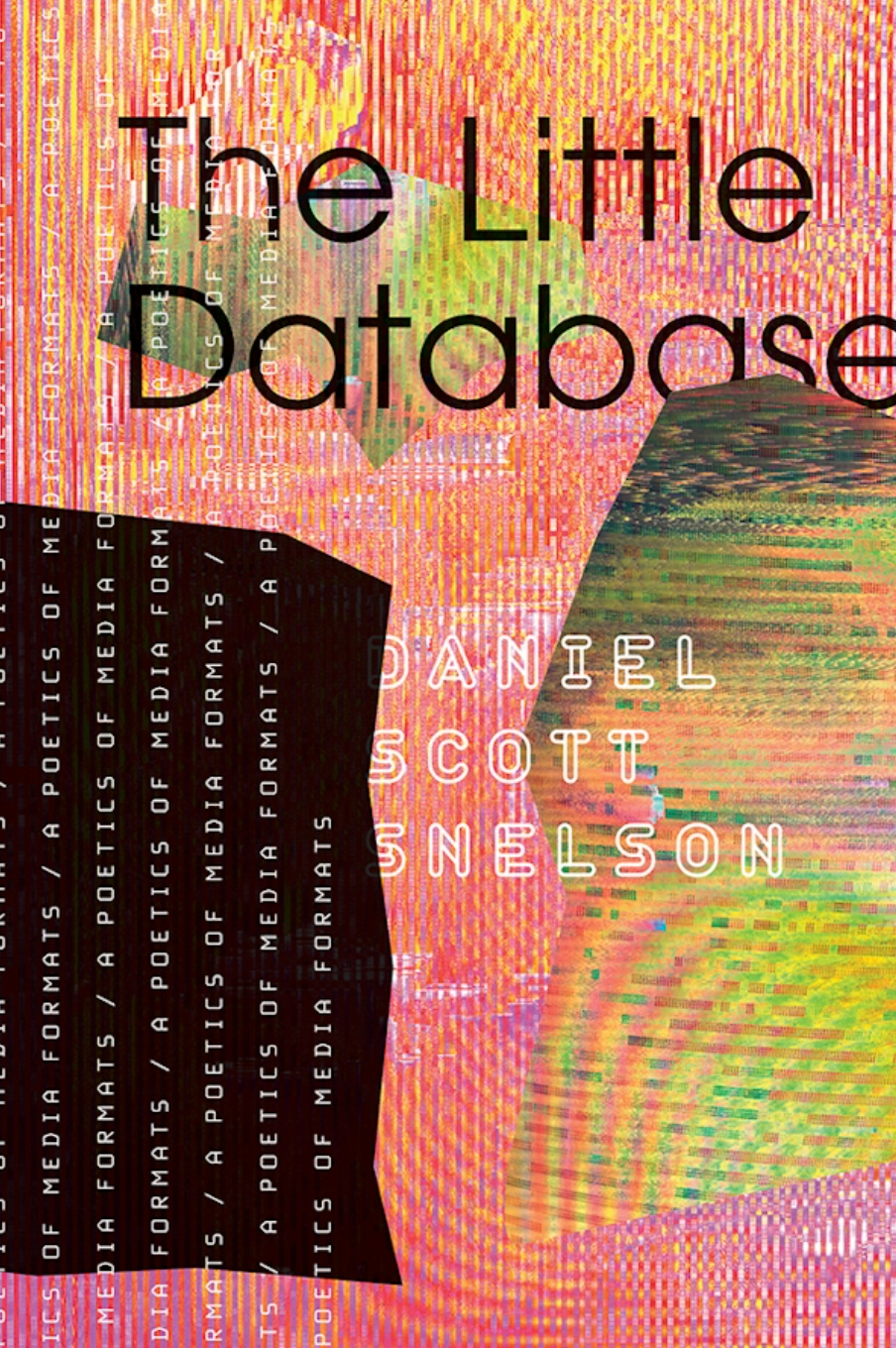
Cover, The Little Database: A Poetics of Media Formats, Courtesy of University of Minnesota Press
REVIEW
The Little Database: A Poetics of Media Formats
By Daniel Scott Snelson
Paperback ($27)
University of Minnesota Press
By Bianca Bova
Daniel Scott Snelson is a writer, editor, and archivist working as an Associate Professor in the Departments of English and Design Media Arts at UCLA, where he serves as a member of the faculty for the Digital Humanities, the Laboratory for Environmental Narrative Strategies, and the UCLA Game Lab. His online editorial work can be found at PennSound, Eclipse, UbuWeb, Jacket2, and the EPC. The Little Database (University of Minnesota Press, 2025) marks his seventh publication, one which positions itself as "a poetics for reading the everyday objects that populate a hard drive."
The first example Snelson chooses to cite in The Little Database is textz.com, a website now defunct for some twenty-odd years (though it hosted 831 plain text files at the time it was abandoned in early 2004) available to anyone with access to an internet browser. Snelson offers it up as an example of "an outlier counterpoint to a range of debates concerning the computational study of digital objects and techniques of literary interpretation formulated within the field."
While considering its pioneering taxonomic place in the broader archival ecosystem that in the author's view encompasses collections (both public and private, it is to be surmised), libraries, archives, and—perhaps more generously—anthologies, he concedes that textz.com and its ilk are often referred to as online archives or digital archives, somewhat errantly. These classifications he argues "would be technically inaccurate given the absence of prepublication materials; and “digital library” doesn’t quite map onto the distribution mechanics or location characteristics of the database." Furthermore, he argues against these aggregators as a type of publisher. "Publisher, with its root in the act of making public, nearly fits, despite the absence of the imprimatur of a press." While fighting these classifications, Snelson does concede that "each of these tags imports a specific set of historical, contextual, and operational frames into our understanding of the site."
From there, he pretty much strays into his own practice, detailing at length an unrealized project that proposed to "exclusively deploy texts within the Textz collection to theorize the site," which Snelson categorizes as a "productive gesture," though one he "abandoned for a number of reasons: institutional, representational, and critical alike." This is the first of a number of instances in which the conceit of the research subject taken up, rather than being run out to the end of its critical tether, instead turns inward on the author.
His dive into the relationship between Eclipse, "a free on-line archive focusing on digital facsimiles of the most radical small-press writing from the last quarter century," and the influential experimental literary magazine L=A=N=G=U=A=G=E of the 1970s and 1980s, edited by Charles Bernstein and Bruce Andrews, and devoted to the publication of out-of-print books and unpublished manuscripts, seems more neatly tied to a legible historical and critical timeline. Particularly where the latter's distribution services arm is concerned. Rather than obtaining a catalog of available titles of out-of-print books and periodicals for a nominal fee from Bernstein, which would then be photocopied on a Xerox machine and delivered to the customer, one can simply browse—or if they desire, print for themselves—a wide selection of works on Eclipse. Not incidentally, one can find a comprehensive archive of back issues of L=A=N=G=U=A=G=E afloat in the phone-book-like index on the website's main directory. Purportedly, access to them has accounted for roughly half of the site’s usage from its inception. Still, Snelson's assertation that "the temporal emendation intensifies the historical engagements that guide the collection," seems to grant more significance to the gesture than may be seen as reasonable—after all, isn't it simply an example of Eclipse serving the exact function it was engineered to serve? Why laud it with such vehemence when anything less would merely constitute an operational failure?
Snelson's observations of the functional and conceptual problems associated with what he refers to as "files-in-transit" frame a more grounded and practical set of questions relevant to collection managers, archivists, registrars, curators, and casual consumers of media alike. He cites William Carlos Williams’ poem The Defective Record (at the end of which Williams' voice mimics the skip-and-repeat of a vinyl record—the format for which the audio piece was conceived of and released on) as a keen example, as its conversion to an Mp3 format (or really, any format which eschews the possibility of a "skip") neuters its effect entirely. This raises all sorts of professional questions related to best-practice regarding means by which the recording might be preserved, presented, and faithfully and effectually delivered to its audiences. Snelson settles for deeming it "necessary to listen to the MP3 of The Defective Record as a digital object in its own right, rather than project an aural experience back to an imaginary Victrola," and somewhat disappointingly, leaves it at that. This is a pattern that continues through Snelson's forays into film, flash artifacts, and obsolete networks. Offering up observations on various systems—however incisive and well-researched those observations may be—without acknowledging their application to the practices which rely on the navigation of these systems, is a bit too much like identifying problems without offering up any solutions.
What is perhaps most odd about this is that the book itself, as an object, seems conceived to be almost wholly pragmatic (albeit only wholly if you overlook the kitsch of chapter headings and other navigational aspects including the full pagination of the book being set in Data70 or a similar font). While it is laid out in a cadence of chapters interspersed with "interludes" and Pages Left Intentionally Blank, these aggrandizing gestures are muted by the inclusion of images (some appearing to be screenshots), data charts, and stills pulled from digital sources. All produced in greyscale, they are sterile; almost aggressively static; antiseptic, even. They feel as though they are born of a hyper-simplified copy-and-paste intervention. There is an undeniable kind of liberation to be found in the automatic defeatism intrinsic to attempting to reproduce the digital world in print. This stark approach to image inclusion feels like the most sincere confrontation of the formatting ouroboros that apparently so torments Snelson.
There is plenty of inalienable truth put forth in The Little Database that makes it a compelling read for our time. Its thorough look at its subject through the span of several decades, from the nascent days of the internet contextualized by dial-up and the dot com boom (and bust), to where we find ourselves today, awash in AI slop and hostage to deliberately opaque algorithmic principles, is at once generous in its spirit of inclusivity, and authoritatively narrow in its focus. Unfortunately, Snelson's internet, and the "little databases" that therein reside, are often cast in so lofty a light as to belie their inherent utility. He seems self-indulgently preoccupied with the conceptual attributes of his subject, at times to the detriment of paying adequate respect to the reality of its design as a toolkit for the masses.
Bianca Bova is a Chicago-based curator and art critic. Her work has appeared in Outside Berlin, Whitehot, and the New York Times, among others. She is a member of the United States section of the Association Internationale des Critiques d'Art and a 2025 recipient of the Dorothea and Leo Rabkin Foundation Travel Grant for Visual Arts Journalism.
Like what you’re reading? Consider donating a few dollars to our writer’s fund and help us keep publishing every Monday.
